Home > Services > FUE Hair Transplant
FUE Hair Transplant
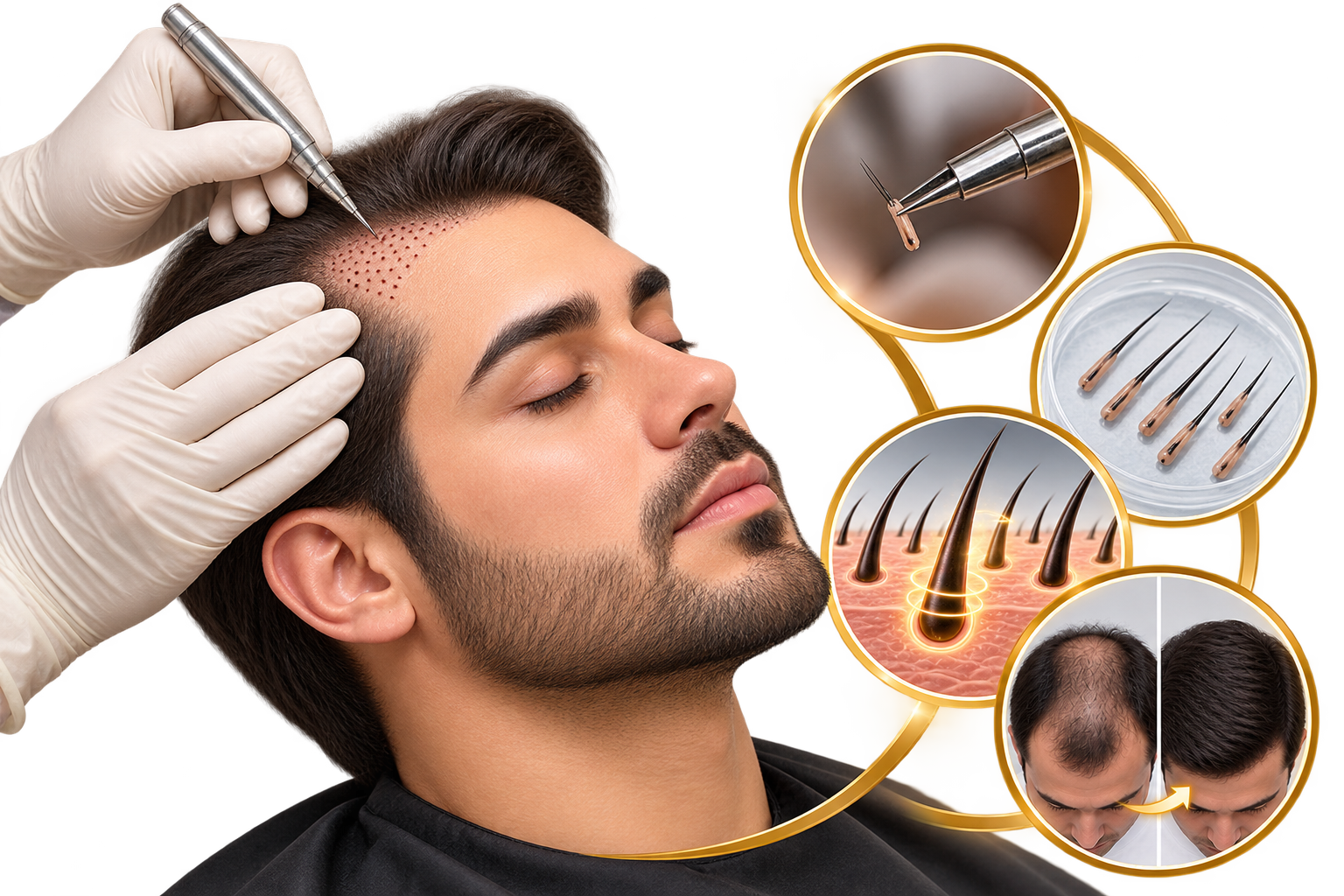
Hair transplantation is a surgical process in which hair is removed from the donor location and transplanted to the recipient/receiver site. The method is mostly used to address male hair loss, such as thinning hair .Hair follicles that are hereditarily resistant to thinning up top (similar to the rear of the head) are transplanted to the bald scalp in this minimally invasive procedure.
Hair transplantation can also be used to restore eyelashes, eyebrows, whiskers, chest hair, and pubic hair, as well as to cover scars from accidents or surgery, such as facelifts and previous hair transplants. Hair transplantation differs from skin grafting in that unions include the bulk of the epidermis and dermis around the hair follicle, and multiple small joins are transplanted rather than a single large join.
Because hair grows in clumps of one to four hairs, current procedures harvest and transplant hair “follicular units” in their natural groupings. As a result, modern hair transplantation can provide a distinctive appearance by replicating unique hair introduction. Follicular unit transplantation is the name for this hair transplant method (FUT). Strip reaping and follicular unit extraction are two methods for collecting benefactor hair (FUE).
Transplant surgery is done as an outpatient procedure, with light sedation (discretionary) and local anaesthesia. Before the contributing scalp is reaped, the scalp is shampooed and then treated with an antibacterial agent.
Hair follicle harvesting can be done in a variety of ways, each with its own set of advantages and drawbacks. In order to ensure the feasibility of the transplanted hair and avoid transection, the clipping of the hair shaft from the hair follicle, proper extraction of the hair follicle is critical, regardless of the collection approach. Because hair follicles form at a tiny angle to the skin’s surface, transplanted tissue must be drained at a similar angle.
Follicular unit extraction (FUE) hair transplant is a state-of-the-art surgical procedure used to treat hair loss by transplanting individual hair follicles from donor areas, typically the back or sides of the scalp, to recipient areas experiencing thinning or balding. FUE offers several advantages over traditional hair transplant techniques, including minimal scarring, faster recovery times, and the ability to harvest hair follicles from a wider donor pool
Trusted Care. Proven Expertise. Real Results. Lasting Confidence.?
Board-certified dermatologists specialize in diagnosing and treating the skin, hair, and nails. They have the expertise to tell you whether the change is harmless or requires medical testing.
Acne is a skin condition that occurs when your hair follicles become plugged with oil and dead skin cells. It causes whiteheads, blackheads or pimples. Acne is most common among teenagers, though it affects people of all ages. Effective acne treatments are available, but acne can be persistent.
Hair transplant, or restoration surgery, can make the most of the hair you have left. During a hair transplant procedure, a dermatologist or cosmetic surgeon removes hair from a part of the head that has hair and transplants it to a bald spot. Each patch of hair has one to several hairs (micrografts and minigrafts).
Best Hair Transplant Surgeon in Pune
Best Skin Treatment Doctor in Pune
Aesthetic Physician, Cosmetologist,
Dermatologist & Trichologist
+91 75586 45757 / +91 72496 71880
ankuja.mhaske@gmail.com
Copyright © 2026 Dr. Ankuja Mhaske